
8th Amendment – Avoidance at all cost?

8th Amendment – Avoidance at all cost?

The 8th Amendment to the Irish Constitution guarantees the equal right to life of the mother and the unborn and makes abortion illegal, but also puts doctors in a very tricky situation if they expect that they can only safe the life of one of the two in disastrous circumstances. The clause was added to the Irish constitution after a referendum in 1983 and many people think that a lot has happened in these 33 years and that the 8th amendment should be repealed (deleted from the constitution.

The supporters of the clause are not overly interested in a referendum because there is the possibility that the opponents will win the referendum. The opponents want to have a referendum as soon as possible to stop the odd situation that women need to travel to the UK to get an abortion that is illegal in Ireland.

So how could we find out what the majority of citizens in Ireland really wants? Let me think? Hmmmm?? Maybe put the head in the sand and pretend that there is no issue? – That seems to be the government’s approach once again! Enda Kenny and his gang are not the most decisive crowd at best of times.

In a true democracy, you would give the citizens a chance to voice their opinion and you would run a referendum if there is evidence that the public opinion could have changed drastically. There is no guarantee that the 8th amendment will be repealed if a referendum happens, but at least we would know then.

Last week the alliance of Anti Austerity Alliance and People Before Profit (AAA-PBP) has asked the government to run a referendum, but that was rejected and the government explains that in the usual way and I will paraphrase VERY VERY freely here:

“We will not ask for the real opinion of the people because we have put in place an artificial structure of a Citizens Assembly that will allow us to delay any decision as long as possible. We gave them loads ot time until half way through 2017 and we hope that they will take that time. Then this Citizen Assembly will come back to us with an opinion. We secretly hope that they will say that no referendum is needed, because then we can blame them. But if they tell us we should hold a referendum, then we will first need to discuss that and at some time later vote on it. Because once the Citizen Assembly comes back with an opinion we will first give that opinion to a Special Oireachtas Committee as this will give us a chance to delay the process further. That Special Oireachtas Committee will be also given six months to decide. So it will be well over a year before we even think about a referendum and we hope that the Irish citizens will have forgotten by then! If the Special Oireachtas Committee ALSO says we should have a referendum then we will CONSIDER to have one and will schedule it for as far away from today as we can. because we are extremely afraid of the outcome and hope that we have won the next election by then so that that referendum will not screw our chances. All in all, we don’t care about the opinion of the Irish Citizens anyway. We only care about our position in power and to maintain that we will do whatever possible to block and delay anything that interfere with our power in the slightest way.”

So with that in mind – and I stress that this is MY interpretation of the situation, but it is based on the government’s official statement as you can find it through this Tweet – there won’t be a referendum for the next 2.5 – 3 years AT LEAST!

In the last 33 years, the opinion in large parts of the population certainly has changed and they have a right to ask for a new vote. Keep in mind that neither side has a guarantee that they will win or lose and that’s not what this opinion here is about. Sure I have an opinion about the 8th amendment, but my opinion is so irrelevant (I am not even allowed to vote in a referendum!) that I just want to focus on the undemocratic-ness of the government’s decision.

We don’t need a Citizens Assembly or a Special Oireachtas Committee! We have clear evidence that there is a ground swell that could indicate that the opinion has changed. That should be enough to ask for the opinion again!

Gaeltacht not viable!? Is that really a surprise?

Gaeltacht not viable!? Is that really a surprise?

As a foreigner, I don’t speak Irish and have never learned it in school. I did make an attempt many years ago to learn it and bought a book and a few cassette tapes (it is THAT long ago!), but I don’t think I made it beyond the first lesson.

Why did I want to learn it? Well, if you move to a country where there is a different language than your own, you at least make an attempt and in addition there is this romanticised idea that it will come in handy somewhere.

But then you realise that ONLY English is needed in Ireland and that apart from some politically inspired publications, there is not even a proper newspaper available in Irish, which is a clear indication to me that the language has been given up.

Is it a terrible thing to give up language that is not useful anymore? Not at all! Otherwise we would all talk in Shakespearian English. Languages change and move, disappear and appear and even if there is history of a language, it does not mean that it HAS to be kept alive. On the other hand, there is NOTHING wrong with keeping it alive if there is sufficient interest and if people want to use it.

The “Oireachtas Standing Joint Committee on the Irish Language, the Gaeltacht and the Islands” was now told last Wednesday by Dr Brian Ó Curnáin from the Dublin Institute for Advanced Studies that the number of Irish speakers is decreasing, that young people’s competence in the language even in the Gaeltacht is declining and that the Gaeltacht in its current state is not viable.

This has been reported by RTE.ie here.

It can’t really come as a surprise! Money is spent on Gaeltacht and on Irish language initiatives and the forced language teaching in Irish schools is still in place. But all this seems (to a non-involved observer) more like state-prescribed or forced programmes and not at all like genuine enthusiasm for the Irish language.

It seems that the language enthusiasm in Wales (for Welsh) is much bigger than in Ireland (for Gaelic). And considering that Welsh only became official language of Wales in 2011, that is some achievement. I am not sure what exactly was done in Wales to get there, but the system used in Ireland is clearly failing, so now the strategy needs to be changed OR maybe it should be considered to let Irish die?

It is “country” not “jurisdiction”!

It is “country” not “jurisdiction”!

Language is a an odd thing! There seems to a sheep effect sometimes when someone uses a term that we think we SHOULD use. Years ago it was the term “non-national”. It was used initially in a misguided effort to be more inclusive by avoiding words like “foreigner” or “alien”. Not the term “non-national” made no sense whatsoever because nearly all “non-nationals” were very much nationals, just not nationals of Ireland, but of other countries. Oddly “non-nationals” was usually only used for non-Irish-nationals from outside the EU. So, it seems we had different classes of “non-nationals”. Luckily the term is hardly used anymore, which is a good thing.

But there are many other words that are used in odd circumstances. “Jurisdiction” is one of them!

Last week, the Irish Independent wrote “A slump in Sterling against the euro prompted hordes of shoppers in this jurisdiction to head across the Border for their pre-Christmas shopping.”

And it quoted Ash Ireland chairman Dr Patrick Doorley, who said “[…] There are many examples of jurisdictions where tobacco price has been increased for health reasons and smuggling simultaneously tackled and reduced – such as Australia, New Zealand and Spain.”

Why is the word “jurisdiction” used in this case and not the word “country”. Every country is a different jurisdiction by definition of sovereignty. The only difference is where a big country, e.g. the USA, can have different laws in different parts (states). In Ireland we don’t have different laws in different parts of the country, so the use of “jurisdiction” makes absolutely no sense.

And just in case “jurisdiction” is used by some to avoid having to call Northern Ireland a different country than the Republic of Ireland: No matter what your opinion is about the political divisions on this island in the future, currently the Republic of Ireland is a completely different country than Northern Ireland and until that changes, the hordes of shoppers in this COUNTRY headed across the border (there is a big hint in this word!!).

Odd behaviour of Ryanair passengers? Are they all beginners?

Odd behaviour of Ryanair passengers? Are they all beginners?

I haven’t used Ryanair for a while. Not because I have a problem with the company, but because they decided to stop flying to where I would like to go in Germany, so I had to go back using Aer Lingus. But this week I flew to Italy and Rome Ciampino was the most suitable airport to fly to. Ryanair flies there and the prices were ok, so we were in business.

Last time I flew with Ryanair they didn’t have any seat allocation yet, but it was a first come, first served approach when you get into the plane. That has changed now and you get seats allocated or (for a surcharge) can select them yourself. The consequence of this is that EVERY single person entering that plane knows exactly that there is a seat waiting for them and they know exactly where this seat is.

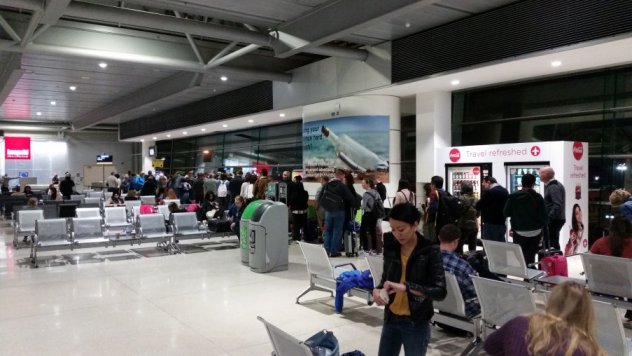
So can anybody explain the scenario in this picture to me? Why do approximately 150 people jump up from their seat as if someone has put needles under their backside as soon as boarding of this plane is even hinted?

Everybody has a seat assigned, so what do you gain by standing there for 10 minutes before the hinted boarding actually starts? Why do people still jump up as if it was a first come, first served seat allocation?

Is it just the space for the hand luggage that gets them to be mad impatient? We got on board as one of the last ones and there was still space for hand luggage.

Human beings are the most irrational species it seems! ;-)

Rewards for people who left the country – Kick in the ass if you weathered the storms!

Rewards for people who left the country – Kick in the ass if you weathered the storms!

One of my pet hates is if a company promotes a really attractive Special Offer and then it says in the small print that it is only available to new customers. It is really a kick up the backside of the loyal long term customers who ensured that the company kept going. Instead there should always be an attractive offer for existing customers IN PARALLEL when a new customer offer is promoted. That offer for existing ones doesn’t have to be the same as for the new recruits, but it should also be attractive.

Bad enough when a phone or Internet company does it or a bank or insurance.But now it gets worse.

The bright lights in our current government are thinking about giving a tax discount to some of the people that have left the country to attract them to come back. Many who left, did so to earn more money elsewhere and many who stayed endured a fair amount of hardship during the recession years in Ireland. And by rewarding the ones who earned more away if they come back is really adding insult to injury.

It certainly makes sense to try to get people to come to Ireland if we have jobs here, but if a reward is considered for returning workers, then the ones that kept the country going shouldn’t be rewarded for their part in the recovery.

www.siliconrepublic.com/careers/tax-rate-returning-emigrants-ireland

 
Malcare WordPress Security