Banning Electric Scooters Won’t Solve Ireland’s Problem

Following a number of serious accidents involving young people on electric scooters, the Irish Government is considering whether electric scooters should be banned.

It took the Irish government years to allow Private Electric Vehicles and in a knee-jerk reaction to appear decisive, they are completely missing the real problem.

Ireland has already tried prohibition.

Until May 2024, electric scooters could not legally be used on public roads. Despite that, anyone living in Dublin knows exactly what happened. The city was already full of scooters. They were used on roads, cycle lanes and footpaths every day. The ban did not stop people buying them. It did not stop people using them. It simply meant that everyone using one was breaking the law.

If a ban did not work before, why would it work now?

The issue has never been the existence of electric scooters. The issue is that the rules are often ignored and enforcement is inconsistent. And that is not scooter problem, it is a general issue that extends to many e-bikes too.

Irish law already limits the maximum speed, sets a minimum age of 16 and defines where scooters may be used. Yet it is common to see children below the legal age riding them. It is equally common to see scooters travelling much faster than the legal limit or being used where they clearly should not be.

When people repeatedly see illegal behaviour without consequences, they begin to assume the rules are optional. That damages respect for the law itself.

Introducing another ban while failing to enforce the current legislation simply repeats the same mistake.

Electric scooters are also part of a much bigger picture.

Across Europe, cities are encouraging forms of transport that reduce congestion, lower emissions and give people practical alternatives to driving. Electric scooters are not perfect, but neither are bicycles, cars or motorcycles. Every form of transport carries risk. The answer has never been to ban transport because some users behave irresponsibly.

Instead, the focus should be on making responsible use the easiest option.

Germany provides an interesting example. Road-legal scooters require insurance and registration, making enforcement straightforward. Ireland should be looking at practical regulatory models like this instead of returning to prohibition.

There is also a gap in Irish legislation. Someone who wants to own a more powerful scooter responsibly has virtually no legal pathway to register, insure and use it. You can buy and insure a motorbike, but you can’t insure a faster scooter. Creating a sensible framework for these vehicles would be far more constructive than pretending they do not exist.

The recent injuries involving children are worrying. However, children under 16 are already prohibited from riding electric scooters on public roads. Those accidents demonstrate a failure to enforce the existing law. They do not demonstrate that responsible adults should lose access to a legitimate means of transport.

The Government has an opportunity to improve safety without turning back the clock.

That means enforcing the existing rules consistently, ensuring the age limit is respected, introducing mandatory helmet use, creating a practical insurance framework for higher-powered vehicles and taking firm action against dangerous riding and illegal modifications.

None of those measures requires banning electric scooters.

Ireland has invested heavily in promoting cleaner transport and reducing dependence on private cars. Electric scooters are one part of that future. Good regulation will make them safer. Prohibition has already been tried and it failed.

The objective should not be to eliminate electric scooters. The objective should be to eliminate dangerous behaviour.

The Corona Files: Social Distancing & Lock Down

The Corona Files: Social Distancing & Lock Down
Sobering Statistics

The Corona Virus is continuing its rampage!

At the time of writing this, there have been 271,620 infections with 87,363 recovered. And sadly 11,280 people have died. That is more than 57 (!!) Ryanair plane loads full of people and imagine how shocked we would be if only ONE plane crashed.

Risk Group or Not: Prevent!

So in actual numbers it is terrifying and a lot of us have started to feel quite anxious or at least concerned about the impact that the virus could have on our own life. It is still the case that the majority of fatalities are in an older age group and/or with people that have some underlying illnesses, but there are plenty of young people that have heart issues or asthma or other circulatory problems that could be badly affected.

If you are in a higher risk group, stay away from other people and wash your hands really well when you have touched items outside in areas where potentially infected people have been and don’t touch your face until you have washed the hands.

With these steps, you will drastically reduce the risk! You will not have to wear a mask, but if you feel safer with a mask or a scarf, then wear it. Fear and anxiety is a bad thing and it doesn’t make sense to suffer it just because you don’t want to be seen with a mask.

If you are super healthy and could have a guarantee that there are no health issues that could require you to be put on a ventilator, it would be best for you and for society as a whole to get infected asap, then completely isolate until the symptoms are totally gone and afterwards be safe from the virus AND not have the risk of being a carrier anymore. Unfortunately, though there is no such 100% guarantee.

There is very good news about immunity: Research on monkeys has shown that immunity will be achieved after an initial infection and once immunity has been achieved, then the monkey who is a second time exposed to the virus will also not pass it on to others anymore. But this research has only been done on a small test group of monkeys and we don’t know either if us human beings react exactly the same as monkeys.

Social Distancing

So to protect the risk groups, the concept of “social distancing” has been developed. The name is very unfortunate, it should be physical distancing or spatial separation, because we don’t want to move away socially from our friends, colleagues and families. But for the rest of this post I will still – reluctantly – use the bad term.

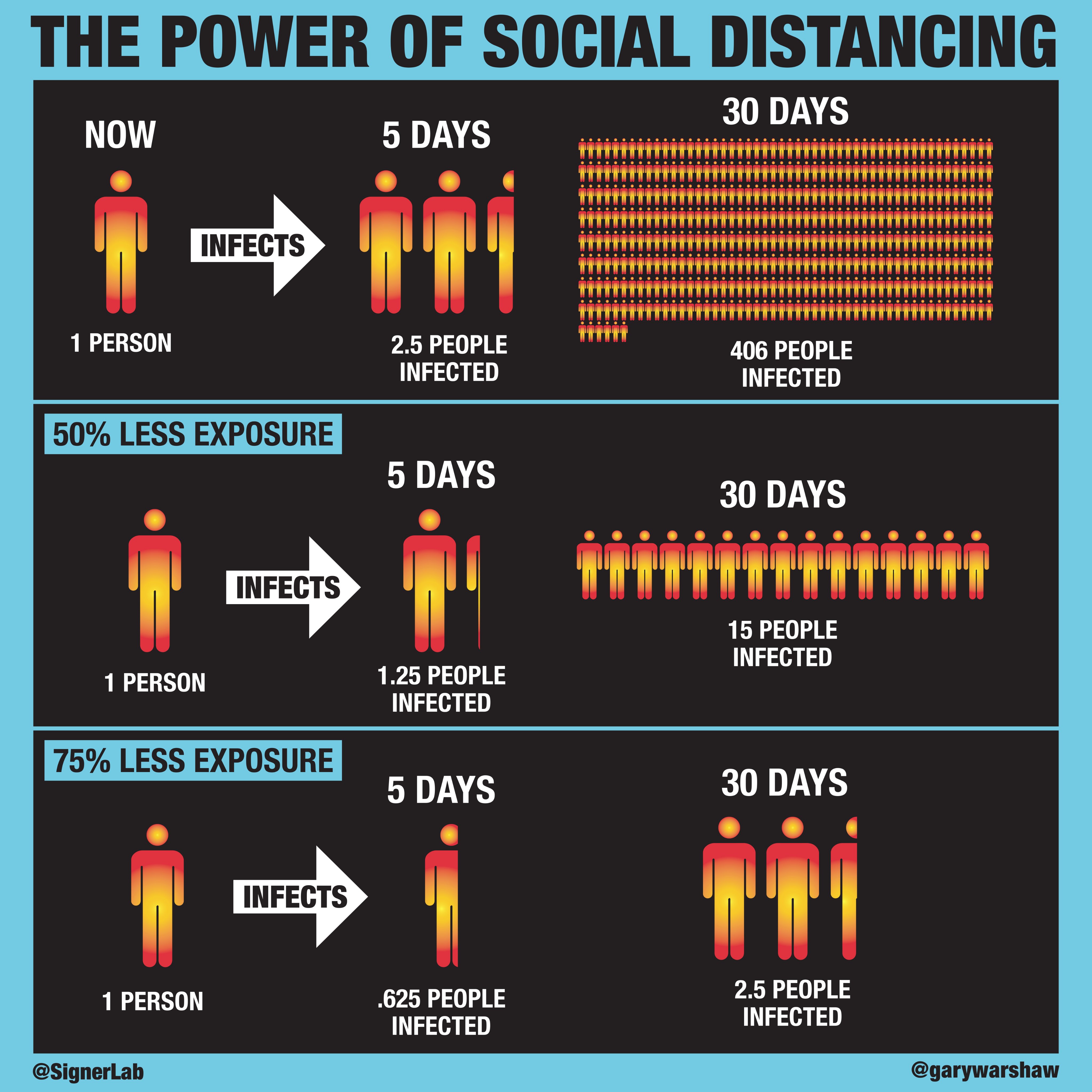
The idea behind social distancing is perfectly expressed in the graph below by @garrywarshaw.
Image

By infecting less people initially, even the multiplication (or compound) effect of an infection chain a significant reduction of total number of infections can be achieved. This is the one and only reason for social distancing.

It does SLOW DOWN the spread of the virus. Social Distancing doesn’t stop it and it also doesn’t stop that we might get infected eventually. But a calculation by a university in the UK showed that just protecting the elderly (for example by locking them away) would not be enough. There would still be 8 times more hospital beds required than they have available.

With a drastic slow down on the other hand, the cases that need to be admitted to hospital will be looked after correctly. A lot of us will still have to get infected to achieve a immunisation (herd immunity) of a larger group of people. So our attitude to an infection has to change! Nobody wants to have a 2 week long bad flu wth the risk of a hospital stay and a low – but still higher than zero – risk of death, but if we accept that it is NOT the worst case scenario if we get infected.

Stigma of Infection

Right now, it seems as if people really think negatively of someone who gets infected. :-O I call that an “Infection Stigma” and it makes absolutely no sense. Getting infected doesn’t mean the person misbehaved, it also doesn’t mean the person is and will remain to be dangerous forever, it doesn’t mean that that person has done society a dis- service and it doesn’t mean that the person will probably die anyway. Not at all!!

The person will most likely survive; has helped society to reach herd immunity faster and does not pose a risk once the two weeks of symptoms are over.

So please stop stigmatising people who got infected by the virus and stop panicking over the possibility that you might get it.

Will we have a lock down?

Nobody wants a lock down really. A lock down means that nobody is allowed to leave the house or apartment anymore unless it is to go to work, to buy food or to go to a doctor.

A lock down is NOT needed where people stick to the social distancing rules. But where people don’t adhere these rules, the only other way to ensure that they stay away from each other is to force them to stay inside.

I saw some pictures from Spain, where a cyclist was fined for going on a training cycle on his own. Yes, he broke the existing law and that is what he was fined for. But the law that he broke didn’t help to improve the Corona virus situation in the slightest. He was NO danger to himself or anyone. In Bavaria in Germany where a moderate lock down is implemented from today, the rules have been created better: You are still allowed to go for a walk as long as it is on your own or only with the people that live with you.

I can understand why the Spanish government used their all-encompassing law, it is MUCH easier to control than a more differentiated law. But this whole situation could take quite some time and rules only make sense if they help improving the situation.

So what can we do in Ireland to avoid a lock down? Simple! Adhere to the Social Distancing rules!!

When will it all be over?

This is one of the most difficult questions to answer. Virologists think that in about 2-3 months it could be over…at least for now. The problem is that when winter returns, the virus could come back.

There is another possible scenario and that assumes that the limitations or restrictions to life are less severe (e.g. schools will restart for higher classes at some point and work will resume) in that case, the restrictions could be lifted then applied again, then lifted and applied again. Whenever the virus comes back the infections will be allowed to rise and then will be controlled through the application of restrictions again. In this on-off scenario, the whole Corona / Covid-19 issue could go on for around 2 years. :-O

I heard about faster tests and a vaccine. Is that true?

Yes and no! Faster tests are being developed at the moment. They will probably be very similar to a pregnancy test where you pee on a strip that tells you instantly through a colour change if you have the virus or not. This is not as easy as it sounds because it has to have a high reliability. But research is on the right path and will probably have a solution relatively soon. Then tests will have to start, which will take another bit. Until then we only have the relatively cumbersome lab test that checks the presence of the virus in a throat swab and – as far as I know – that also can detect antibodies as indicators that you had been infected.

A vaccine is also not too far away from being developed. But even when scientists found a vaccine, that doesn’t mean that you will be able to get it. Currently vaccines needs to go through a very long and expensive trial process, which could delay the availability for patients for another 12-18 months based on current regulatory rules. But maybe the rules will have to get changed so that at least health professionals can be vaccinated earlier. But there is a risk of severe side effects and politicians have to decide if they want to accept this risk (and insure the vaccination producer against it).

What should I do for now?

Three things:
1) Stay upbeat and positive by creating a new routine during the isolated living
2) Adhere to all Social Distancing rules and if necessary, obey the lock down.
3) Keep in close contact with people that live on their own, with elderly people and with anybody else who could do with your support. Isolation is a challenge for most people and we need to be there for each other to get through it. Be proactive with your friend. Don’t wait for them to tell you they need help, but contact them regularly to check if they need anything.

We all go through the same situation and a shared experience can pull people together and will provide the support needed so that everyone can get through it. If you are strong, provide the support and if you are challenged ask for support! Let’s help each other and be there for each other!!

 

Total ban of “single-use” bags? Don’t overdo it!

Total ban of “single-use” bags? Don’t overdo it!

We (hopefully) all know about the environmental problems plastic causes. We see regularly pictures and read reports about animals that were interfered with by getting caught in or swallowing items made of plastic. The plan is to forbid forks and knives, straws and plates and cups made of plastic and while there is a lot of sense in some of this, there is the possibility to go overboard a bit in an over-exaggerated “we have to do something” drive.

Ireland was one of the earlier countries to charge for the use of plastic bags and in the meantime MANY countries caught up or even did better by forbidding certain type of plastic bags. But at a visit in Germany a few months ago, I came across a situation that showed me that we really can overdo it!

I was in a middle sized town and had a look at some shops without any clear intent to buy something. C&A, a big clothes shop, was also there and I went inside to have a look. They are known for good quality for low prices. Not as low as Penney’s, but still very competitive. And while having a look around, I found a T-Shirt that I really liked and one or two other items that looked great and were at the right price.

So I went to the till and pushed the clothes across the counter to pay. The employee behind the counter scanned the labels of the three items and pushed them back to me. :-O I looked at her in a quizzical way and she said “Oh, do you need a bag?” I said “Do you have a paper bag?” Her reply: “No, we don’t do paper bags, but you can buy a plastic bag.” :-O :-O

I had no interest in using a plastic bag, but I also didn’t want to walk out of the shop with three pieces of clothing clenched under my arm just because I hadn’t pre-planned the purchase and therefore didn’t bring my own bag!!

Is it too much to ask to get at least the flimsiest of paper bags to put your purchases in if you go clothes shopping? C&A also sells suits and evening dresses. Would you not think that it is in the interest of the shop to provide customers with basic means to bring their garments home unblemished?

I am all in favour of protecting the environment, but that experience did annoy me quite a bit. I could have bought a plastic bag, but I decided not to (for environmental reasons), so I DID walk out of the shop with three items of clothing clenched under my arm. :-O

Weather Shambles in Ireland!? Can we handle the weather?

Weather Shambles in Ireland!? Can we handle the weather?

Before I start into this article, let me state – for the avoidance of any doubt – that neither the Irish government nor Irish Water can be made responsible for the weather. Irish politicians would probably love to lay claim to organising the most suitable weather for their constituents and Irish Water is never at fault about anything at all anyway, but we will have to let them off the hook regarding their weather responsibility. :-)

The question that I came across during the week does, however, have something to do with Irish authorities and with their ability (or not!) to forward plan and to do what we need them to do when it comes to weather challenges.

Weather is an important topic in Ireland! We love to talk about it and even more to complain about it. We don’t really have any weather extremes, but you wouldn’t know that if you listen to weather news or read just a normal newspaper.

Oddly, though, we seriously struggle as soon as something out of the ordinary (i.e. 13 degrees and scattered showers) happens. If we have 2 cm of snow, the country comes to a stand still. Traffic collapses, schools close and the country stops operating. On the other end: Give us around 20 degrees for a few weeks with no significant rain fall and we are (nearly) running out of drinking water.

Is this normal? Well, there are countries in Europe that regularly have significant snow fall and just keep going. And there are other countries where they know they will have hardly any drop of rain from Spring until end of Autumn and still, people will water their lawn and drinking water is plentifully available.

We claim that we are not used to it and therefore we struggle dealing with it. Hmmmm, Middle Europe (around Germany) had temperatures of above 35 degrees for well over a week and they are also not used to it, but life continues. Water is still there despite very little rain this year. Mallorca, Fuerteventura and the south of Spain (just to mention a few popular places) have no rain at all in the summer, but there doesn’t seem to be a hosepipe ban. And if we look at the other end of the year: Snow is never guaranteed in parts of Middle Europe. But if there is snow, then they deal with it and continue!

When will we start to prepare for increasing temperatures, lack of rain and occasional snow? The holes in the water pipes need to be plugged asap, we need more deep wells to get better water than surface water and we need to think about water desalination.

But what about winter time? We now do have salt and we have snow ploughs and still there is panic and mayhem. Do we need new rules? Make Winter tyres compulsory? Make it compulsory that house owners clean the footpath?

What do you think would fix the problems in summer and in winter?

“Hosepipe Ban” – Are they for real??

“Hosepipe Ban” – Are they for real??

When I read this, I thought it was a Waterford Whispers News story. (Waterford Whispers News is an Irish satirical news website that usually hits the nail on the head with their brilliant headlines.) The announcement that made me think it is a joke was the announcement by Irish Water on Friday that from Monday 02 July a “hosepipe ban” would be in effect in the Greater Dublin area.

At first I thought it is Irish Water nonsense, but checking into it a bit more I realised that a piece of Irish Law really mentions that the “use of water drawn through a hosepipe” can be prohibited for the use of “watering a garden, watering recreational parks or sports grounds […], irrigating or spraying crops […], or washing a mechanically propelled vehicle or a trailer”.

Water conservation makes sense if there is a shortage and due to the idiotic way public water supplies in Ireland are ONLY served from surface water in lakes and reservoirs (instead of using water from underground sources) we are currently entering a period of water shortage. BUT a “hosepipe ban” just sounds like a ridiculous piece of law.

The ban will be in place for the whole month of July and if someone is found in breach of the ban, they could be fined EUR 125.

But here comes the interesting stuff:

While the wording above is taken from the “Water Services Act 2007”, Irish Water is NOT banning all wasteful water use. Instead they reduce the ban to “watering a garden, cleaning a private motor-vehicle using a domestic hosepipe. […], filling or maintaining a domestic swimming or paddling pool (except when using hand held containers filled directly from a tap), […]” so that means if you use a domestic hosepipe you are not allowed to clean the car, but if it is a commercial hosepipe, you can go ahead without any issues. It also means that your swimming pool must not be filled via hosepipe, but if there is a tap above the swimming pool OR if you get LOTS of big containers and fill it by hand, you are all above the law.

 
Malcare WordPress Security